|
Plastics film extrusion speeds have been
increasing over the last decade. Speeds of typical lines have increased
by atleast 70-100%. For instance, 10 meter wide large BOPP film
lines with a capacity of almost 30,000 Mta, are required to run
at speeds of 600-800 Meter/Minute. The high running speeds exert
more demand on winders.
The winders today are expected to provide very low tension and yet
maintain uniform winding at such high speeds. This is possible because
all the modern winders are AC driven and not operated by DC drive.
The maintenance of the AC driven winders compared to DC drive is
much low, making AC the preffered drive for winders. In the current
scenario, practically all winders have made the switch to AC drive.
Tremendous amount of development work has been carried on by machinery
manufacturers in the last 10 years to make them more efficient and
accurate.
The prime advantage of AC drives is not the speed, but low maintenance.
DC drives have brushes that have to be replaced and can run at lower
speeds only with external air cooling. AC drives have no brushes,
don’t need cooling, are more precise and have greater speed
range. More recently, AC servo drives have been used instead of
AC vector types to give more accurate speed and position control.
With DC drives, speed and torque are not linear, and at speeds below
10% there is no torque at all. On the other hand, AC motors—both
vector and servo—have absolutely linear torque development
from zero to maximum speed. That means that a DC drive has a usable
speed range of about 80:1; and AC vector or servo drives have a
2000:1 range. New-generation winders can also maintain lower tensions
at lower line speeds than ever before—an advantage with soft,
thin webs like prestretched stretch film and with blown films. Blown
film is inherently less even in gauge than cast, so it needs to
be wound more loosely to make a flat roll. If stretchy films are
wound too tightly, thin areas get thinner, and thick areas become
ridges. With thin films, the gauge variation may be smaller, but
a roll accumulates many more layers, so the total effect of the
variation on roll quality may be greater. Blown film winds typically
at 100 meters/minute and up to 200 meters/minute for thin HDPE blown
film can wind at up to 300 meters/minute.
Older winders are being rebuilt with new drive motors, electronics
and load cells at two-thirds the cost of a whole new winder. All
the film processors have to look at improving the cost to remain
competitive. High productivity is the way to go where new generation
winders play an important role.
Previous Article
Next Article
Tell Us What You Want
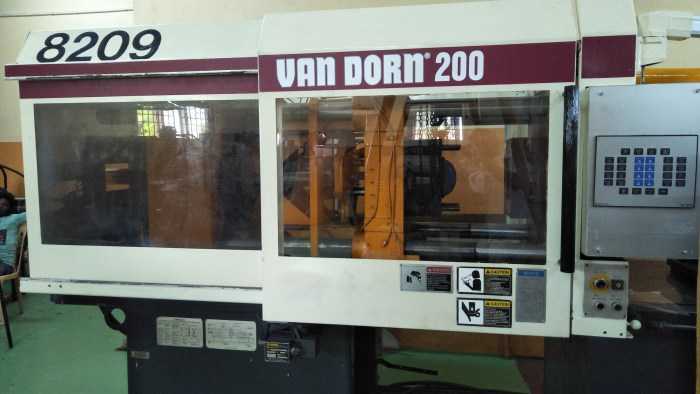
200 ton Van Dorn high speed injection molding machine
| | | |