|
Over the last two decades, Pthalate Plasticizers
have come under considerable concerns over health and environmental
issues. Consequently, phthalates have been researched in great depth
to assess their risk to humans. The studies have shown conclusively
that Phthalates are not carcinogenic. The effect of Phthalates,
particularly of higher molecular weight Phthalates such as DINP/DIDP,
on reproductivity too has not been proven. However BBP/DBP/DOP have
been classified as category 3 for BBP/DBP and category 2 of DOP.
These categories essentially indicate that there is a serious concern
and suspicion about a possible effect of BBP/DBP more than DOP on
intrinsic hazards on reproductivity. Higher Phthalates are however
considered to be safe.
Studies on the impact of Phthalates on the environment have not
shown any conclusive evidence that they cause any toxicity problems
to the aquatic organisms. This, because Phthalates have poor solubility
in water. Hence Higher Phthalates are bound to have lower solubility.
The lower molecular weight BBP/DBP/DOP have been classified as substances
that are considered to be of some suspicion.
All these studies have not provided any conclusive evidence. It
is therefore not surprising that phthalates continue to have more
than 80% share of the total plasticizer consumption. However over
the last few years DINP/DIDP have grown much faster compared to
DOP. Infact, DOP's share has been going down to almost 35 - 40%
from 60-65% over the last decade. Interestingly nonphthalate plasticizers
have not been gaining any higher market share. Several nonphthalate
plasticizers like citrates or sulfonates have been unable to replace
phthates on account of cost performance.
BASF has recently developed a new plasticizer called DINCH (Di
lsoNanylCycloHexane Dicarboxylate).
This is a general purpose plasticizer like Phthalate and has no
reproductivity toxicity. DINCH is likely to be targeted at medical
products, toys and food products. The first plant of 25kt capacity
is being commissioned by BASF this year. The convertors of toys
or medical products certainly would have another option in place
of Phthalates.
Previous Article
Next Article
Tell Us What You Want
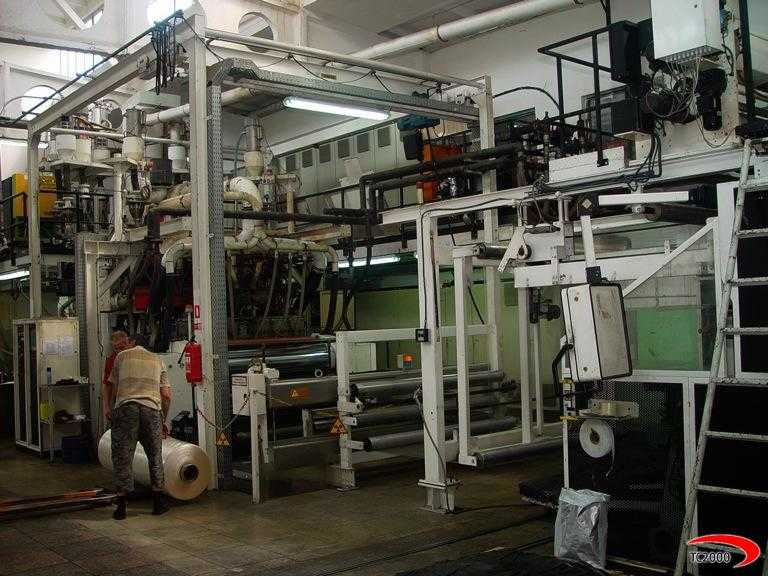
Windmoller and Holscher 5 layer cast film line
| | | |