 |
 |
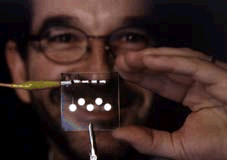
| Bayer physicist
| Bayer physicist
- Dr. Andreas Eischner with a fully operational
prototype diode, used for test purposes.
Photo
courtesy: Bayer AG |
Off on a family holiday... Mom and Dad in the front of the car,
kids in the back, happily watching TV. TV? Mounted on the back of
the front seat is a wafer thin screen on which watch their favorite
cartoon characters. Once they arrive at their hotel, Dad removes
the screen, rolls it up and once inside, pins it on the hotel room
wall and the show goes on.
Science fiction? In the foreseeable future it will be science fact.
Conventional construction of TV screens, monitors and displays could
soon become a thing of the past.
The key to this revolution is organic light-emitting diodes and
a new material developed by scientists at Bayer, the chemicals and
health care group called Baytron P. Baytron P is an electrically
conductive plastic which considerably extends the working life of
the diodes and also has made it possible to make screens so thin
and flexible that they can be rolled up when needed.
The phenomenon of electrically luminescent organic materials (extremely
delicate structures which light up when electrical voltage is applied)
has been known for over half a century. But the material used then
proved to be too unstable and the light yield was so low that no
thought was given to any practical applications.
Then five years ago Bayer scientist Rolf Wehrmann and his colleagues
made the breakthrough. They had been given the task of finding organic
substances from which light-emitting, wafer-thin and flexible film
could be made. The objective was to make flat screens which are
no longer dependent on projection from the back as the text and
pictures appear, thanks to the organic diodes.
The transparent Baytron P they developed, increases the working
life of light-emitting diodes dramatically. A 10,000 hour, non-stop
test of the brightness of a computer monitor was passed with ease.
"Baytron P was a quantum leap in the development of displays
made with organic materials," says Wehrmann.
He is not alone in his opinion. Already electronics giants such
as Philips are using Baytron P to develop the screens of
tomorrows, super-thin screens, made entirely of plastic, and safe
because of the low voltage used. And the optical characteristics
are outstanding, high contrast, no reflection and capable of being
viewed from a very oblique angle.
The first telephones with the new displays are already in the market.
Video recorders, cellular phones, watches and CD player will follow
soon. In the longer term Philips plans to add navigation systems
and car instrument panels to the range of applications.
And the TV screen at the back of the family car? "We should
be there in 10 years," Philips' Jan Robert Visser confidently
predicts.
Previous Article
Next Article
Tell Us What You Want
500,000 Lids / day thermoforming machine
| | |