|
With consumption of almost 88 million
tons in 2002, polyolefins dominate the plastics family. They continue
to grow at about 5-6%, not only because of the overall economic
growth, but their capability of widening applications and thereby
eating into some volumes of other materials including the other
plastics.
This has been made possible because of continuing developments
in catalysts as well as processes. Most of these Polyolefins are
about 50 years old and have seen 5 distinct generations of catalysis
developments. Developments have been in the field of Ziegler catalysts
required for all Polyolefins except high pressure LDPE and some
other products like EVA.
The fifth generation Ziegler catalysts enhance productivity as
well as widen molecular structural capabilities required to widen
the application spectrum. Single site catalysts have opened other
areas of controlled addition of comnomer as well as characteristics
like molecular weight distribution and significant reduction of
lower molecular weight species. While the single site Metallocene
catalysts brought significant enhancements on LLDPE, the Ziegler
catalysts have developed significant improvements in the morphological
as well as molecular architecture of the polymer.
Basell Polyolefins, the largest producer of PP has recently introduced
another component in the form of internal donor, considered to broaden
the MWD of PP produced by gas phase process. This new catalyst system
would improve the processability of film grades required for very
high capacity modern film equipments.
The new component Ethyl Benzoate is used in place of the earlier
internal donors like Phthalates, Diether and Succinates. This internal
donor also increases the bulk density of the polymer powder. The
increased bulk density would help the PP producers to produce the
granules at higher output rate and thereby reduce the capital cost
of the extrusion line. In fact, the maximum output per plant could
go up from the existing 250-300KT to 350KT.
Similarly, process developments have helped Polyolefin producers
to produce at an economic rate. In addition, these developments
have helped in manufacture of copolymers with much higher impact-rigidity
balance, not possible a few decades ago. The advent of gas phase
from the late 70s and the latest development of multizone circulation
to enhance homogenity of the polymer particles are some examples
of innovation in process developments.
Previous Article
Next Article
Tell Us What You Want
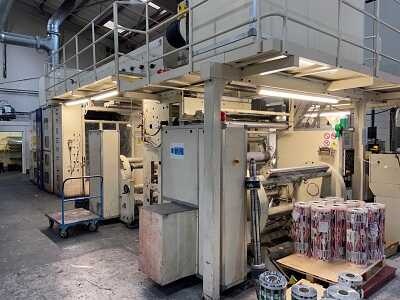
Carint Cyberflex 8 colour gearless CI flexo printing press
| | | |