|
Plastics fuel tanks in automobiles
have been in existence for over three decades. The first plastic
fuel tank was installed in the 1969 Porche model. In fact, today
more than 90% of European cars and 70% of North American cars are
fitted with plastics fuel tanks. Yet! The Asian car manufacturers
seem to remain aloof from the plastics fuel tank, evident in the
fact that plastics fuel tanks are fitted in only 10-15% of Asian
cars.
What factors lead to the non preference of plastics fuel tanks in
Asia?
The predominant presence of small cars in Asia, having lower weights
as compared to the European and North American cars could be a major
reason. The major driving force; weight saving; does not exist in
Asian cars. Or is it that labour required to assemble metal tanks
is cheaper in Asia and therefore savings in the form of labour does
not provide enough incentive for the changeover? Or the minimum
economic size restricts its usage in Asia? The mould of fuel tanks
is quite expensive and needs orders of larger size to amortize its
cost.
All these factors contribute to the fact that plastics fuel tanks
for automobiles are not yet preferred in Asia.
Will this trend reverse in the near future?
Plastics fuel tanks made from high molecular weight HDPE along
with co-extruded EVOH are very widely used in European and North
American cars. High molecular weight of HDPE provides toughness
and more uniform thickness distribution on account of higher melt
strength. EVOH provides the required resistance to fuel vapour to
prevent loss of fuel. The plastics fuel tanks obviously provide
corrosion resistance, the only alternative to such corrosion resistance
being stainless steel. Most of the Asian cars use metal sheets which
are not effective in corrosion resistance.
The fuel tank is generally manufactured from extrusion blow moulding.
However, it can also be manufactured by thermoforming process. PE
fuel tank manufactured by thermoforming, though not yet fully established,
is being used by one of the big Australian cars.
The plastics fuel tanks have excellent resistance to loss of fuel
vapour and meet all the present emission norms. However, the new
emission law to be introduced in 2005 in California would demand
extensive development work, particularly from the connection / joints
that are the most prone to leakage. This law will demand less than
0.054 grams of fuel loss/day. Will this new law reverse the trend
in favour of stainless steel tanks in North America? Or will the
plastic moulders, along with HDPE suppliers like Basell and Solvay
rise to the occasion with newer developments?
Previous Article
Next Article
Tell Us What You Want
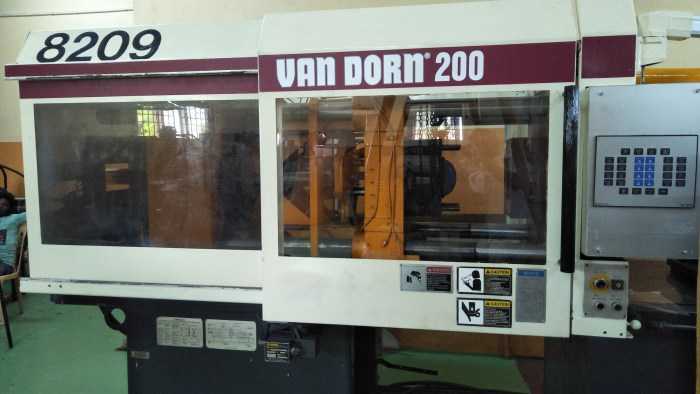
200 ton Van Dorn high speed injection molding machine
| | | |