|
Carbon nanotubes are unique nanostructures
with remarkable electronic and mechanical properties. Structures
based on carbon nanotubes offer an array of possibilities for nanometre-scale
electronic applications. In a manner similar to carbon fibres used
in composites to strengthen a structure or to enhance the electrical
conductivity of the main constituent, carbon nanotubes could be
combined with a host polymer to alter physical properties to specific
applications. Superb conductors of heat and infinitesimal in size,
carbon nanotubes might be used to prevent overheating in next-generation
computing devices or as fillers to enhance thermal conductivity
of insulating materials, such as durable plastics or engine oil.
Since carbon nanotubes are very small, they could be used in polymer
composites that could be formed into specific shapes, or in a low-viscosity
composite that could be sprayed onto a surface as a conducting paint
or coating.
Recently, a very interesting research conducted at Rensselaer Polytechnic
Institute has revealed that carbon nanotubes may not act as a superconductor
when mixed with polymers. This is in contradiction with what was
originally envisaged when the nanotube was found to increase thermal
conductivity by 2-3 times when incorporated at only very small level
in the polymer matrix. It has been observed that carbon nanotubes,
though superior thermal conductors by themselves, will not exhibit
the same level of high conductivity when integrated into other materials.
Independent groups of scientists conducted computer simulations
on model nanotube composites as well as some physical experiments
and found the interfacial resistance between nanotube and other
insulating material very high. This high resistance may limit the
thermal conductivity of nanotubes. This possibly is the first evidence
that what looked to be very promising regarding development of good
conducting plastics material may not be as easy. Scientists now
believe that both thermal and electrical conductivity of polymer
will increase, but not very significantly.
However, an optimism exists about the use of carbon nanotubes to
improve insulating materials. So although expectations have to be
lowered, there is scope for nanotubes to improve materials for a
number of other applications.
Previous Article
Next Article
Tell Us What You Want
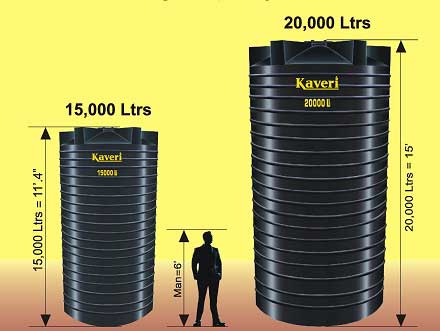
Large capacity chemical storage tanks
| | | |