







 12-Nov-26
A reusable cup becomes truly useful only when it is supported by a system that can identify, collect, wash and return it to circulation. The cup itself is important,
but the real circular-economy value lies in the infrastructure around it. At stadiums and large events, this creates a design challenge. Operators need reliable identification for inventory control, return tracking and repeated-use measurement. Brands, however, want the cup to remain visually clean. A conventional printed QR code can interrupt artwork, reduce the premium appearance of the product and make a reusable cup feel like a piece of logistics equipment.
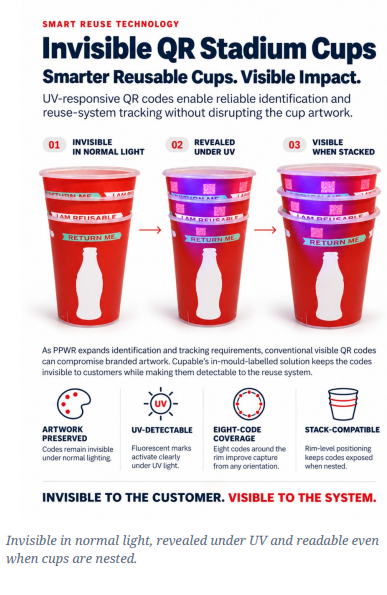
Invisible QR technology offers a practical way through this conflict. UV-responsive codes are integrated into the in-mould label near the rim of the cup. Under normal lighting, the codes remain largely invisible to the customer. Under controlled ultraviolet illumination at a collection or processing point, they become detectable by the reuse system.
For stadium applications, multiple codes can be positioned around the circumference. This improves the probability of capture from different orientations and allows the codes to remain accessible when cups are stacked. The result is a cup that preserves the brand experience in the customer’s hand while still supporting the operational discipline required behind the scenes.The larger lesson is simple: circularity cannot be printed onto a product as a claim. It must be designed as a measurable operating system. Identification technology helps connect the physical package with data on circulation, loss, washing and recovery. That information can help operators improve return points, understand asset utilisation and build accountability into reuse programmes.
Invisible QR codes are therefore not merely a printing innovation. They are an enabling layer for reuse at scale—making the system visible without making the technology intrusive.
Previous News
Next News



{{comment.DateTimeStampDisplay}}
{{comment.Comments}}